Read
Every employee has a dossier: behavioral profile, what they want, what they fear, their history, and how they get on with the other five. Teams have to use it.
Six people. Six different ways of being led. One turnaround.
Most leadership training teaches people what good leadership looks like. Team Turnaround makes them do it, on six real personalities who each need something different, under time pressure, in front of their peers, with a scoreboard running.
Most organizations can name their leadership model. Far fewer can point to managers who apply it in the moment that counts: when a likable over-promiser misses a deadline again, when a quiet expert stops contributing without ever complaining, when the person who is technically right is damaging the team every time they open their mouth.
Those moments don't get solved by knowing the framework. They get solved by reading the individual person in front of you and choosing an approach that lands with them, without lowering the standard.
That's a skill. Skills need reps. Team Turnaround gives your managers twenty-four of them in a single session.
Participants inherit a capable but struggling six-person team. Commitments are being missed. A change has been announced but not adopted. One person is quietly carrying work that belongs to everyone else. A high performer is protecting standards while damaging trust. An expert has stopped offering anything beyond the job description. And speed and caution have hardened into rival camps.
Senior stakeholders have given the team six rounds to turn it around, ending in a final review.
Teams of six play together on their own laptops, discussing each situation and submitting one shared leadership decision. Every decision changes the team they inherit in the next round, and every other team in the room is making different calls with the same people, the same facts, and the same problem.
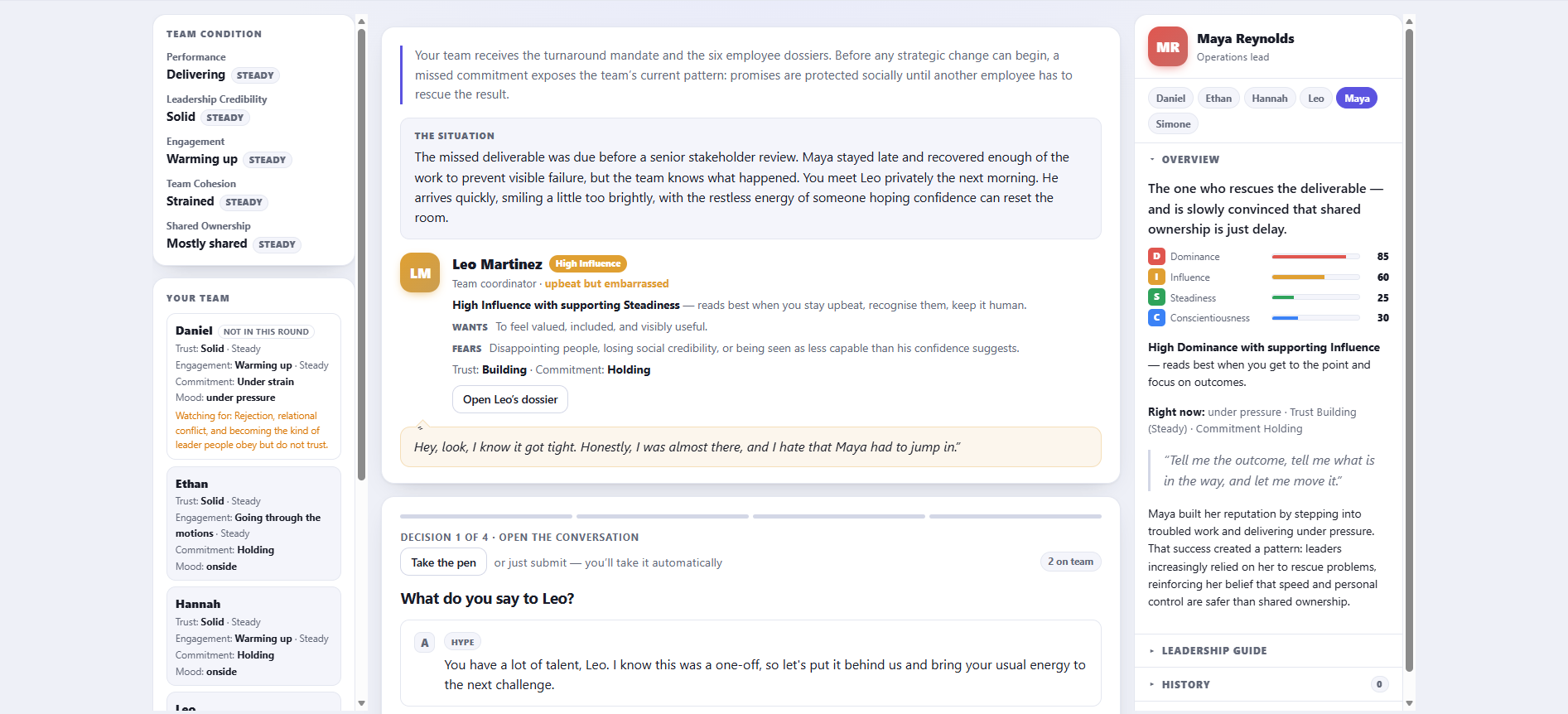
The situation, the person in front of you, and the team's live condition on one screen. Teams read the profile before they choose how to respond.
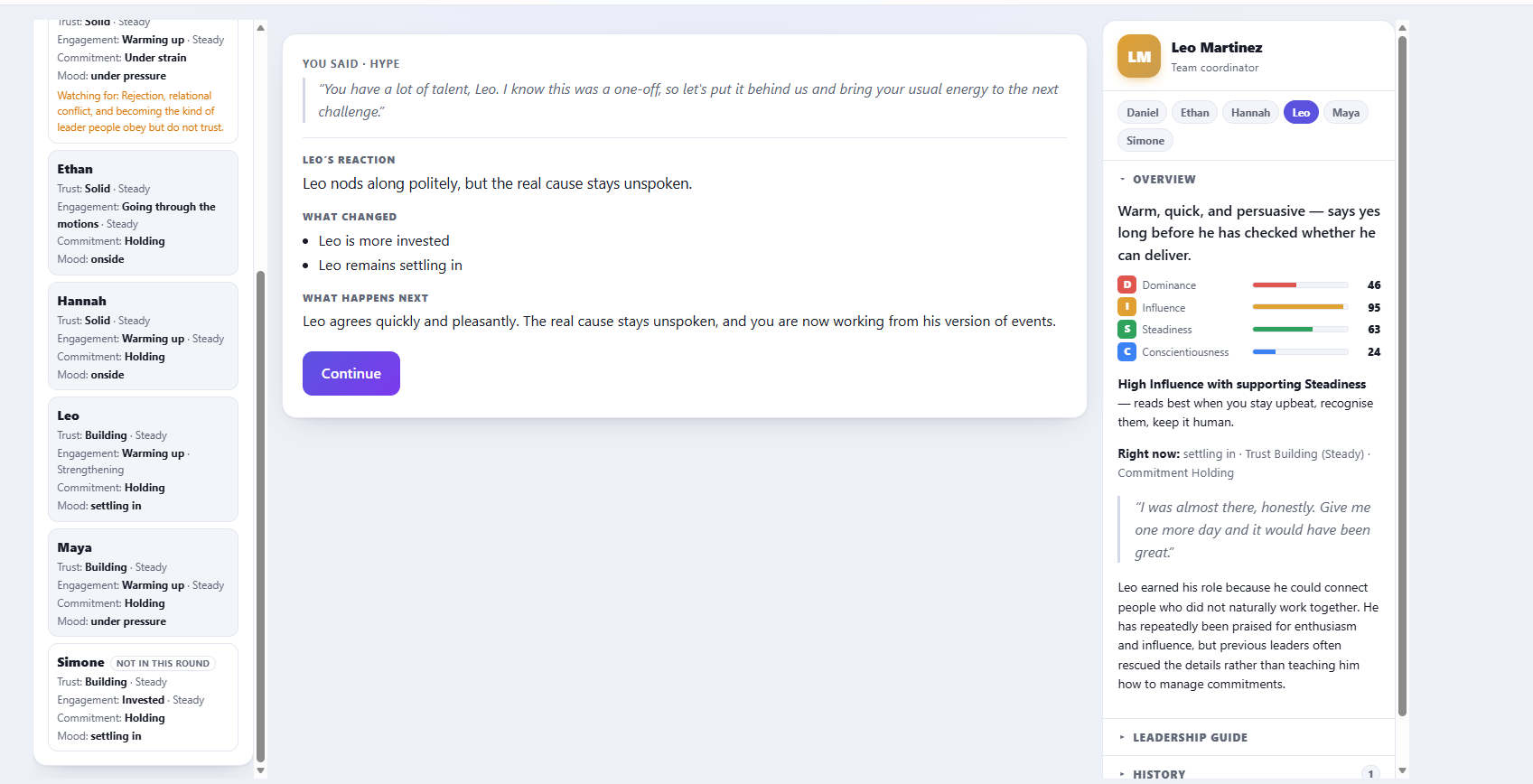
Every choice comes back with the reaction it earned, what shifted on the team, and what it sets up for the next round.
Each of the six characters is built on a distinct behavioral profile drawn from the widely used DISC framework: dominance, influence, steadiness and conscientiousness. Each one responds differently to the same leadership move.
The point is not to label people. The point is that the same message, delivered two different ways, produces two different outcomes, and a good manager can tell the difference before they open their mouth.
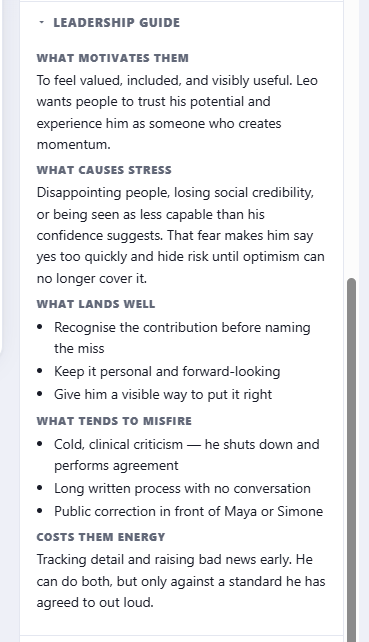
What motivates them, what lands, and what quietly misfires.
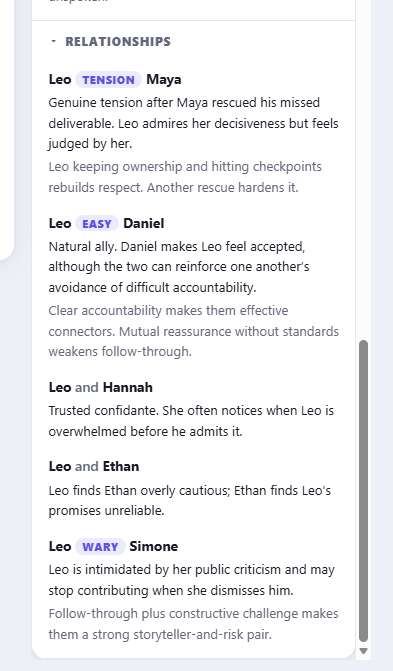
Every relationship on the team, and what strengthens or hardens it.
Every employee has a dossier: behavioral profile, what they want, what they fear, their history, and how they get on with the other five. Teams have to use it.
Each decision offers several defensible options. They differ in tone (direct, supportive, analytical, collaborative), not in whether they're "the right answer".
Being liked isn't winning. Options that flatter the person while ducking accountability score badly. Teams learn where warmth ends and avoidance begins.
Team Turnaround uses the general DISC behavioral framework for training purposes. It is not a psychometric assessment and is not affiliated with, or endorsed by, any assessment publisher.
None of them are villains. All of them are recognizable.
Team Coordinator
The popular over-promiser. Says yes to everything, hides bad news until optimism can't cover it, and desperately doesn't want to disappoint anyone.
"I was almost there, honestly. Give me one more day and it would have been great."
Team Support Specialist
The quiet resister. Never objects in the room, then keeps doing it the old way, because she's seen changes arrive with fanfare and leave a mess behind.
"People will follow the instruction. That is not the same as knowing what to do when something goes wrong."
Collaboration Lead
The rescuer. Everyone trusts him, which is exactly why he ends up quietly doing everyone's work rather than risk a difficult conversation.
"I thought I was protecting the relationships. I can see now that people may not even realize I have taken their work back."
Strategy & Risk Lead
The one who's right. Catches what everyone else misses, and dismantles people in the process, then wonders why nobody speaks up anymore.
"Was anything I said factually wrong? Because if accuracy becomes secondary to comfort, we have a much larger problem."
Quality & Planning Specialist
The switched-off expert. Still accurate, still on time, and has completely stopped offering an opinion, because the last several were ignored.
"I am still doing what the role requires. I stopped investing in recommendations that were never going to affect the decision."
Operations Lead
The one who gets it done. Delivers under pressure every time, which is precisely why she's stopped trusting anyone else to carry their share.
"I can work with risk. What I cannot work with is waiting for certainty that is never going to arrive."
Each round is a stage of the turnaround, not a disconnected coaching exercise. What your team does in Round 1 is still in the room in Round 6.
A deliverable is missed before a senior review, and someone else stays late to rescue it.
Restore the commitment without teaching the team that rescue is the system.
A new way of working was launched. Nobody objected. Two weeks later, half the team is quietly still doing it the old way.
Find the real barrier before the adoption deadline.
The most trusted person on the team is drowning, because delegated work keeps finding its way back to their desk.
Build real ownership without breaking the relationships that made them trusted.
Your sharpest performer just prevented a serious failure, and flattened three colleagues doing it.
Keep the rigor. Change how it happens.
Nothing is failing. Someone has simply stopped contributing beyond the minimum, and there's no performance problem to point at.
Re-engage them with something real, not a pep talk.
Twenty-four hours before the stakeholder review, speed and quality collide in public and the team starts choosing sides.
Integrate the two, or pick a favorite and live with it.
Every team presents its result to the senior stakeholder. Depending on six rounds of decisions, that's a genuinely stronger team, a fragile recovery propped up by two people, or activity that never became change.
Up to six teams of six. Everyone joins on their own laptop with a simple join code: no accounts, no installs, no pre-work.
The situation appears on every screen. The team debates it out loud. One person submits the shared decision, and it updates instantly for everyone.
No team moves on until every team has finished. That's the debrief moment: six teams have just answered the same question differently, and the trainer works with that live.
Standings are shown at facilitator-chosen gates. Competitive enough to keep the energy high, gated so nobody can coast on an early lead.
Team Turnaround is a practice environment. The value shows up in what people can now do differently on Monday.
The default setting is deliberately generic, so the simulation works in any sector on day one. Role titles, work products, stakeholders, processes and policy constraints can all be swapped to match your organization. The human conflict and the leadership standard stay exactly the same.
That means a version that sounds like your business, without rebuilding the simulation.
The fastest way to understand Team Turnaround is to play a round of it. Book a walkthrough and we'll run you through the opening scenario the way your people would experience it.
Request a Demo